National Financial Educator Standards and Financial Literacy Standards in MENA

Defining Educator Excellence to Strengthen Financial Literacy Instruction

The NFEC created the first and only standards for financial educators designed to elevate both the quality and the impact of financial literacy instruction. These standards outline the essential personal finance knowledge every educator should master, along with the best practices proven to strengthen teaching effectiveness across all core content areas.

Our goal was simple: make high quality financial literacy standards publicly accessible so educators and organizations have a clear roadmap for improving financial capability and driving stronger long term outcomes. These remain the first – and only – standards created specifically for MENA financial educators.

Research consistently shows that learners taught by qualified instructors experience significantly better results. They retain more knowledge, build higher lifetime earnings, enjoy greater retirement security, and report improved overall well being. In fact, students taught by highly qualified educators achieve more positive outcomes across the board – from financial stability to mental and physical health – than those taught by less prepared instructors.

Accredited & Independent

As the only Accredited Provider in the financial education space to establish industry standards for financial educators in the MENA region, the NFEC sets the benchmark for excellence in teaching personal finance. Our framework reflects proven best practices for educators – covering instructional design, learner-centered methods, measurable outcomes, and professional ethics – so organizations and learners can trust the quality of instruction delivered by instructors.

Importantly, the NFEC developed these standards independently, without sponsorship or outside funding that might shape content or priorities. That independence ensures that our standards are driven solely by what produces real learning and behavior change – clear, defensible, and focused on measurable impact for learners, employers, and communities.
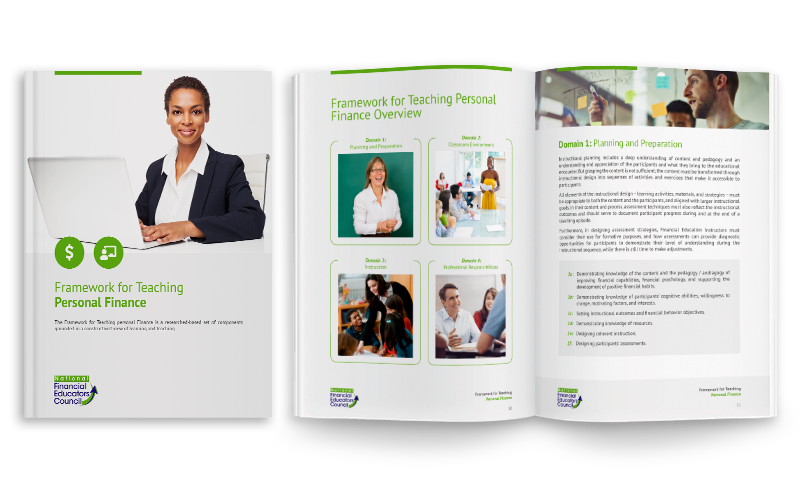
Standards for Financial Education Practitioners – Framework for Teaching Personal Finance

The NFEC developed the Framework for Teaching Personal Finance, the first and only international industry standards for financial education instructors. The Framework sets clear, practical benchmarks that help educators teach more effectively and equip learners with real-world financial skills.

Created with the Danielson Group and a multidisciplinary team spanning education, psychology, finance, and program evaluation, the Framework is aligned with InTASC core teaching standards. Adapting Charlotte Danielson’s model for financial literacy and grounded in constructivist learning, it defines 22 evidence-based components that specify the knowledge, competencies, and observable practices instructors must demonstrate. The Framework provides a roadmap of instructional practices tied to measurable participant gains.

Backed by research and widely accepted by educators, administrators, and policymakers, the Danielson Framework is the most commonly used teaching model in the U.S., adopted in more than 20 states; and also widely recognized globally. The NFEC’s adaptation brings that same rigor to financial education, delivering a defensible, standards-driven approach that improves instruction and documents learner outcomes

Certification Tour, Graduate Features, & Bonus Presentation Resources

  • CFEI® Tour: See how the program works and explore the journey step by step.

  • Graduate Features: Hear real stories from instructors making an impact.

  • Bonus Resources: Get exclusive teaching tools to elevate your financial education programs.

This is more than a course – it’s your opportunity to join a global network of educators committed to empowering individuals and communities with practical, life-changing financial skills.

By accessing the NFEC’s material, you agree to comply with the full terms.

Join Over 5,000 Enrolled CFEI® Champions Providing Others Qualified Financial Education

The NFEC Provides Standards for Financial Educators – The Groups Below Provide Standards for Learners

NFEC educator standards work in tandem with student learning standards by ensuring that instructors are equipped to deliver content that aligns with defined financial competencies and measurable outcomes. Together, they create a complete system where teaching quality and learner achievement are directly connected.

National Financial Literacy Strategy / Financial Education Framework

United Arab Emirates

Lead organization:
Central Bank of the UAE and federal education/financial stakeholders

Description:
The UAE has expanded national efforts around financial capability through central bank regulation, consumer protection frameworks, and school-based money education initiatives. While not a single codified law titled “financial education standards,” the UAE approach functions as a national framework for financial literacy standards through coordinated financial inclusion, investor education, and youth financial capability programs. These efforts increasingly align with broader economic goals under “We the UAE 2031” and consumer financial protection priorities.

Financial Consumer Protection Regulation (2021)

United Arab Emirates

Lead organization:
Central Bank of the UAE

Description:
Although primarily a consumer protection regulation, this framework requires licensed financial institutions to provide clearer disclosures and improve consumer understanding of financial products. It indirectly establishes financial education standards by promoting informed financial decision-making and responsible banking behavior among consumers. The regulation supports national financial wellness and literacy objectives.

National Financial Inclusion and Financial Literacy Strategy

Qatar

Lead organization:
Qatar Central Bank

Description:
Qatar developed a national strategy focused on both financial inclusion and literacy to improve public knowledge of banking, insurance, savings, and SME finance. The initiative is widely referenced as a country-level benchmark for financial literacy standards and public financial education policy. The strategy was designed using population surveys to identify financial capability gaps and underserved groups.

Third Financial Sector Strategy (2023–2030)

Qatar

Lead organization:
Qatar Central Bank

Description:
Qatar’s Third Financial Sector Strategy strengthens financial inclusion, digital finance, and consumer capability as part of national development planning. While broader than education alone, it reinforces national financial education standards by encouraging public financial awareness, access, and responsible participation in the financial system.

Financial Awareness & Capability Programs (Vision 2030 Alignment)

Saudi Arabia

Lead organization:
Saudi Central Bank and national partners

Description:
Saudi Arabia’s financial literacy ecosystem operates through national financial awareness campaigns, banking-sector consumer education, and savings initiatives aligned with Vision 2030. While not codified into a standalone statute, these initiatives collectively function as de facto financial education standards for consumer finance knowledge, savings, digital payments, and responsible borrowing.

Financial Sector Development Program (Vision 2030)

Saudi Arabia

Lead organization:
Saudi Central Bank and Vision 2030 partners

Description:
Part of Saudi Vision 2030, this program supports financial inclusion, consumer empowerment, and public financial capability. It advances national priorities that resemble financial literacy standards, particularly around savings culture, fintech participation, and access to financial products.

Financial Education Curriculum

Israel

Lead organization:
Ministry of Education

Description:
Israel has a structured school-based financial education curriculum that integrates money management, budgeting, savings, loans, investments, and consumer responsibility into educational programming. This is one of the clearest examples of formalized financial education standards in the MENA region, with curriculum guidance spanning age groups and school levels.

Financial Literacy Curriculum for Secondary Education

Israel

Lead organization:
Ministry of Education

Description:
Israel’s upper-secondary financial literacy curriculum provides a formal framework for teaching budgeting, smart consumption, loans, inflation, and financial responsibility. The curriculum functions as a practical benchmark for national financial literacy standards in schools.

Financial Inclusion Strategy (2022–2025)

Egypt

Lead organization:
Central Bank of Egypt

Description:
Egypt’s national financial inclusion strategy includes financial literacy as a core pillar for economic empowerment, especially among youth, women, MSMEs, and underserved communities. Though broader than education alone, it provides a national framework that supports financial education standards and structured public financial capability efforts.

National Financial Literacy Campaign

Egypt

Lead organization:
Central Bank of Egypt, in partnership with the EU, GIZ, and the Egyptian Banking Institute

Description:
Egypt launched a national campaign delivering structured public financial education on banking, entrepreneurship, payments, inflation, and consumer finance. The campaign supports national financial literacy standards by creating accessible educational content and encouraging informed financial decisions.

Financial Inclusion Strategy (2026–2030)

Egypt

Lead organization:
Central Bank of Egypt

Description:
Egypt is developing a second-generation national financial inclusion strategy that continues to prioritize financial capability, citizen awareness, and cross-ministerial coordination. The strategy builds on earlier frameworks and reinforces long-term national financial education standards.

School-Based Financial Education Initiatives

United Arab Emirates

Lead organization:
UAE education authorities and private-sector partners

Description:
Recent UAE student financial capability programs, including school-based investor education and savings initiatives, are helping define practical financial literacy standards for youth. These initiatives emphasize budgeting, investing, and money management skills through applied learning.